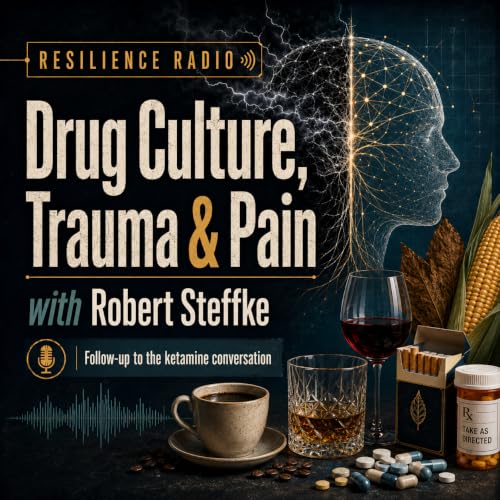
Cover of Resilience Radio

Resilience Radio

Resilience Radio

By: Irvin Eisenberg: Occupational Therapist Structural Integrator
Listen for free

Season's Savings | 0.99 €/month for 3 months

5.99 €/month thereafter - terms apply. Cancel monthly.
Resilience Radio is a place for healthcare professionals to talk about the heart of their work as well as be a resource and inspiration for Vermonters in thinking about how to nurture our resilience both as individuals and as a larger community.Resilieince LLC Copyright Hygiene & Healthy Living Science
Episodes
  • Ep. 110: Martial Arts, Pain, and the Body's Alarm System | Paul Coffey
    19 Oct 2026

    In this episode of Resilience Radio, Irvin Eisenberg shares an edited conversation from his appearance on Paul Coffey's martial arts podcast, Keep Kicking.

    They explore the overlap between martial arts, occupational therapy, pain neuroscience, trauma, and body awareness. The conversation looks at why pain is not always a direct measure of tissue damage, how the nervous system responds to perceived threat, and how gradual, controlled exposure can help rebuild confidence in movements that have become feared.

    They also discuss board breaking, slow-motion sparring, self-preservation training, the risks of comparing one injury or trauma to another, and the idea of pain as an alarm system that deserves attention rather than automatic suppression.

    Irvin Eisenberg, OT/L, is the owner of Resilience Occupational Therapy in Vermont.

    Show more Show less
    36 min
  • Ep. 109: Drugs, Culture, Ketamine, and the Fear-Pain Connection | Robert Steffke
    20 Jul 2026

    Why are alcohol and caffeine treated as ordinary parts of daily life while other mind-altering substances remain heavily stigmatized?

    In this follow-up conversation, Irvin Eisenberg and psychotherapist Robert Steffke explore how culture, legality, intention, and context shape our relationships with substances. They consider how social acceptance can be influenced by criminalization, and what changes when substances once used in cultural, ceremonial, or medicinal contexts become commercialized or routinely consumed.

    Robert reflects on his own experience with addiction recovery and time spent in 12-step communities. He describes recognizing when substance use was helping him avoid pain and disconnect from life rather than engage with it—and the value he found in supportive community and in experiencing life without mind-altering substances.

    The conversation then turns toward the relationship between pain and fear. Robert shares a personal experience of encountering physical pain without the usual fear surrounding it and considers how fear can intensify or shape painful experiences.

    Irvin and Robert also discuss ketamine-assisted psychotherapy, trauma, and the possibility of observing a difficult experience without feeling completely overwhelmed or defined by it. They explore how distance, support, and self-compassion may allow someone to develop a different relationship with pain or an experience from the past.

    This episode follows an earlier Resilience Radio conversation with Robert about ketamine and his psychotherapy practice. Listening to that episode first may provide useful context.

    CHAPTERS

    00:00 — Drugs, Culture, and Social Acceptance
    Why some mind-altering substances are treated as normal while others remain taboo.

    01:33 — Intention Behind Substance Use
    Robert reframes the discussion around purpose, enhancement, and conscious choice.

    02:01 — Criminalization and Cultural Stigma
    How policy, criminalization, and social judgment can influence cultural attitudes.

    03:32 — Context, Moderation, and Sacred Plants
    Tobacco, corn, coffee, and what can happen when something is removed from its original context.

    05:29 — Everyday Substances, Addiction, and Recovery
    Robert reflects on recognizing when substances were creating disconnection rather than helping him engage with life.

    07:03 — Experiencing Pain Without Fear
    A personal story about separating the experience of pain from the fear surrounding it.

    08:28 — Ketamine, Perspective, and Pain
    How gaining some distance from an experience may change a person's relationship with pain.

    10:19 — Trauma as an Unintegrated Experience
    An analogy about childhood injury explores how support may affect the way a painful experience is carried forward.

    12:23 — Meeting the Past with an Adult Self
    Robert describes approaching earlier experiences with care, perspective, and greater internal resources.

    13:02 — Closing Thoughts
    A brief conclusion and invitation to hear the previous conversation.

    RESOURCES

    Resilience Occupational Therapy
    https://resiliencevermont.com/

    Music: "Some Biological Process" by Aaron Marcus
    https://aaronmarcus.bandcamp.com/

    DISCLAIMER

    This conversation is provided for educational and informational purposes only and is not medical advice, diagnosis, or treatment. The opinions expressed by the guest are his own and do not necessarily reflect the views of Irvin Eisenberg or Resilience Occupational Therapy.

    Show more Show less
    14 min
  • Ep. 108: Non-Ordinary States: Ketamine-Assisted Therapy, Trauma, and the Healing Power of Connection | Rob Steffke
    15 Jun 2026

    Episode Description

    In this episode of Resilience Radio, Irvin Eisenberg and Rob Steffke explore ketamine-assisted therapy, trauma, non-ordinary states of consciousness, and the healing power of relationship and connection. This conversation looks at how ketamine may support therapeutic work, why "set and setting" matter, and why the medicine itself is only one part of the process.

    Key topics include:
    ✅ What makes ketamine-assisted therapy different from recreational ketamine use
    ✅ Set and setting, intentionality, and the role of the therapeutic relationship
    ✅ Trauma, depression, the observer mindset, and non-ordinary states of consciousness
    ✅ Why integration before and after a session may be as important as the session itself
    ✅ The importance of not having to move through difficult experiences alone
    ✅ The limits of one-on-one therapy and the need for broader community support
    ✅ Practical considerations, including readiness, collaboration with an existing therapist, insurance, and cost

    Rob Steffke, MA, LMFT is a psychotherapist whose work includes training therapists, ketamine-assisted therapy, body-oriented approaches, and an interest in how non-ordinary states of consciousness can support healing and personal change.

    Rob Steffke:
    https://www.psychologytoday.com/us/therapists/rob-steffke-nevada-city-ca/269308

    Listen on Libsyn:
    https://directory.libsyn.com/shows/view/id/resilience

    Watch on YouTube:
    https://www.youtube.com/@ResilienceOTRadio

    Book an Appointment with Irvin:
    https://scheduling.go.promptemr.com/onlineScheduling?w=356&s=DL

    Music Credit:
    "Some Biological Process" by Aaron Marcus
    https://aaronmarcus.bandcamp.com/track/finlays-menopausal-fridge-some-biological-process

    SHORT EPISODE SUMMARY
    Rob Steffke joins Irvin Eisenberg to discuss ketamine-assisted therapy, trauma, non-ordinary states of consciousness, and why healing often depends on relationship, preparation, integration, and the experience of not being alone.

    Show more Show less
    34 min
adbl_web_anon_alc_button_suppression_t1
No reviews yet