Cover of Parent Teacher Interview

Parent Teacher Interview

Parent Teacher Interview

By: Joshua MacWilliams
Listen for free

Season's Savings | 0.99 €/month for 3 months

5.99 €/month thereafter - terms apply. Cancel monthly.
Parent Teacher Interview explores the educational journey of our children and the successes and challenges that they will inevitably experience along the way. We delve into ways we can support our children throughout their schooling and discuss the transition to school, child development, building independence and resilience and a wealth of other topics that you may experience both for you as a parent and for your child in the amazing world of education.Joshua MacWilliams Parenting & Families Relationships
Episodes
  • Understanding Occupational Therapy: Regulation, School and Everyday Life
    24 Oct 2026

    In this episode of the Parent Teacher Interview Podcast, I'm joined by Cheri from WonderGlow OT for a conversation about what occupational therapy can look like in everyday life.


    We explore how OTs work alongside children and families, why parent coaching can be just as important as working directly with a child, and how the right support depends on the individual child, their family and the environments they spend time in.


    We also discuss the importance of collaboration between families, teachers and allied health professionals — and some of the practical challenges that can get in the way.


    In this episode, we explore:

    • What occupational therapy is and some of the misconceptions surrounding it.

    • Why therapy isn't about fixing a child, and why understanding the reasons behind a challenge matters.

    • The role of parents and caregivers in supporting progress beyond the therapy session.

    • Why goals need to reflect a child's priorities, capacity and circumstances.

    • Common areas of support, including emotional regulation, transitions, handwriting and self-care.

    • How OTs can work in homes, schools and clinics to understand a child's everyday environment.

    • The challenges of communication between teachers and allied health professionals, and how whole-class strategies can help create more inclusive classrooms.

    • Pathways families may explore when seeking occupational therapy, including private services, Medicare rebates, private health insurance and the NDIS.

    • The uncertainty around changes to disability and early childhood support, including Thriving Kids, as discussed in the episode.


    A key takeaway from this conversation is that meaningful support is rarely the responsibility of one person alone. When we understand what a child is finding difficult, listen to what matters to them, and work together across home and school, we can make everyday participation more achievable.


    About Cheri

    Cheri is an occupational therapist who supports children and families. Through WonderGlow OT, she provides client services and develops resources. She also created the Charge Your Mind regulation program and the Battery Boot Camp book, and co-hosts the podcast OTs Figuring It Out.


    Find Cheri's work

    • WonderGlow OT: https://www.wonderglowot.com.au/

    • Charge Your Mind: https://chargeyourmindprogram.com/

    • OTs Figuring It Out: https://www.buzzsprout.com/2556273


    A note on funding: This episode includes a discussion of Australian Medicare, private health insurance, the NDIS and Thriving Kids. Funding rules and eligibility can change, so please confirm current requirements with the relevant service or official government source before making decisions.

    Thanks for listening to the Parent Teacher Interview Podcast — the space between home and school.


    Music Credits

    • “Ember” — The Lakes

    • “Green Leaves” — The Lakes

    Music sourced via Uppbeat.


    Show more Show less
    49 min
  • Being Good Enough, Asking for Help and Making Sense of AI
    10 Oct 2026

    In this solo episode, I'm reflecting on a couple of recent conversations on the podcast and the ideas that have stuck with me long after the microphones were switched off.

    After chatting with Danica from Little Bloom Consultancy and Craig Smith from Universal Sandpit, I've been thinking about what it means to be a good enough parent and educator, why asking for help can be so difficult, and how small moments of joy can change the way we move through a challenging day.

    I also revisit some of the ideas Craig shared about AI, empathy and the ways we interact with technology. From thinking differently about people whose experiences aren't the same as our own to using AI to help make sense of our kids' Japanese homework, these conversations have given me plenty to consider — particularly as a parent and teacher trying to work out how we help children engage with AI safely and responsibly.

    This isn't about having all the answers. It's about noticing the ideas that stay with us, questioning some of our assumptions and working out what we might do differently as a result.

    In this episode, I reflect on:

    • What it means to be a good-enough parent and educator.
    • Why asking for help matters, and why it can feel so hard.
    • Finding the micro-moments of joy in busy and challenging days.
    • The double empathy problem and understanding different perspectives.
    • AI, relationships and the ways people use technology to connect, learn and grow.
    • Helping children develop safe and responsible ways of interacting with AI.

    I'd love to hear what has stuck with you from a conversation, a piece of advice or something you've read recently. What have you been thinking about, questioning or trying to put into practice?

    Come and join the conversation over on Instagram at @parent_teacher_interview_pod.

    If you enjoy the podcast, follow or subscribe so you don't miss an episode.

    Show more Show less
    27 min
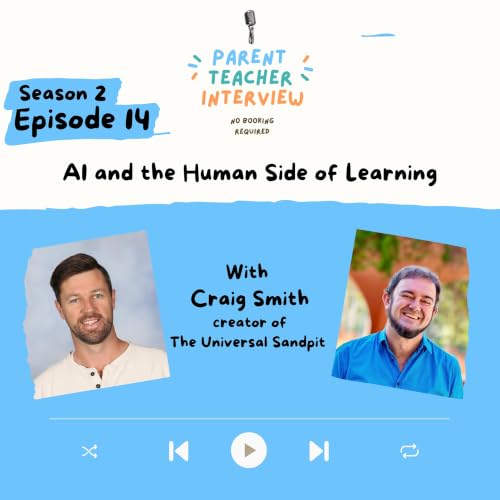
  • AI and the Human Side of Learning with Craig Smith
    26 Sep 2026

    AI and the Human Side of Learning

    Season 2, Episode 14 — with Craig Smith

    AI is a topic that can divide a room pretty quickly.

    For some, it represents exciting possibilities for the way we learn, work and support one another. For others, there are important questions around safety, privacy, creativity, critical thinking, the environment and what we might lose as these technologies become a bigger part of our lives.

    In this episode, Josh sits down with Craig Smith, Manager of Technology and Innovation at Positive Partnerships, educator, author and international speaker, and creator of The Universal Sandpit.

    Rather than trying to find all the answers, this conversation explores some of the questions.


    Josh and Craig talk about:

    • How AI might support executive functioning, including planning, organisation, task initiation and managing thoughts.
    • Craig's idea of the “administration team of the brain” and what this might help us understand about the challenges some students experience.
    • Using AI as a tool for reflection, conversation and scaffolding, rather than simply outsourcing our thinking.
    • Neurodiversity and AI, and why different people may experience and use technology in very different ways.
    • The idea of double empathy and how it might change the way we think about AI, social interaction and what we consider “normal”.
    • How we can support children to understand what AI actually is, rather than treating it as a magical black box.
    • Finding the balance between safety and experimentation when children and young people are learning about new technologies.
    • Craig's “mountain” analogy and the importance of allowing children to develop their own thinking rather than using AI as a shortcut.
    • How AI can support creativity and play, including Craig's experience of creating a video game with his son.
    • The Universal Sandpit and the practical AI tools Craig has developed to support inclusive education.
    • The potential for AI to help educators connect students' strengths and interests with classroom learning.
    • The ethical questions surrounding AI — including the potential environmental, social and workplace impacts — alongside the possible benefits for inclusion and accessibility.


    One of the ideas we keep coming back to is that two things can be true at the same time: AI can create significant challenges, while also offering opportunities that may genuinely benefit some students and educators.

    And perhaps that's the point of this conversation. We don't have all the answers yet — but there is value in asking the questions, exploring what is possible and trying to understand how different people experience these technologies.


    Where to find out more about Craig

    The Universal Sandpit — Craig's collection of AI-powered tools and resources for inclusive education. The site currently includes tools for educators and students covering areas such as executive functioning, lesson planning, differentiation, visual supports, task analysis and more.

    The Universal Sandpit

    Craig Smith on LinkedIn — Craig regularly shares his experiments, ideas and work around AI, education, neurodiversity and technology.

    Craig Smith on LinkedIn

    Find out more about Craig


    Music Credits

    🎵 “Ember” — The Lakes
    🎵 “Green Leaves” — The Lakes

    Music sourced from Uppbeat.

    Show more Show less
    1 hr and 11 min
adbl_web_anon_alc_button_suppression_t1
No reviews yet