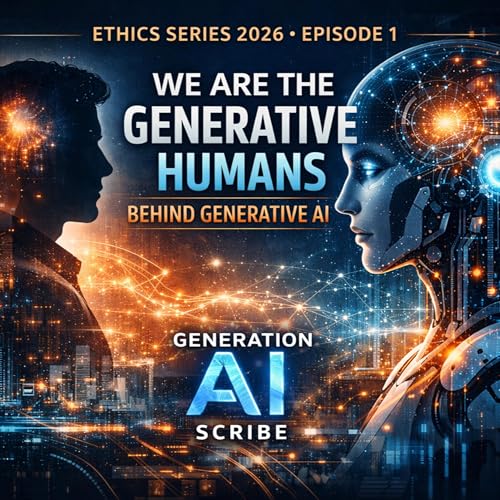
Cover of GEN AI SCRIBE

GEN AI SCRIBE

GEN AI SCRIBE

By: Dr. Sam Egburi
Listen for free

Season's Savings | 0.99 €/month for 3 months

5.99 €/month thereafter - terms apply. Cancel monthly.
This is GEN AI, science sets truths, what if science is not enough? what if the truths of today were seen as aberrations in the past? In contrast, today’s aberrations could be truths in the future. This podcast is an attempt to log facets of life of our contemporary thinking, challenge them if needed, and open our mind to the possibilities. I am Dr. Sam Egburi, and I am the GEN AI SCRIBE. as an academic in Information Systems Management, I will talk about science, sociology, productivity, psychology, creativity, spirituality, join us and learn more about us via digitalcontentcreative.com.Dr. Sam Egburi Art
Episodes
  • The End of Online Anonymity: When AI Knows Who You Are and What You’ll Do Next S3 E1
    25 Sep 2026
    What Happens When Online Anonymity Disappears?

    In this episode of GEN AI Scribe, we explore a near-future world where every device, account, transaction, and online action is connected to a verified human identity.

    Imagine accessing the Internet and being identified automatically through your phone number, government records, address, financial history, banking information, health data, legal records, and the devices connected to your network.

    Every click has a name attached to it.

    At first, this may sound safer and more convenient. Verified identities could reduce fraud, fake accounts, bots, identity theft, cybercrime, and online abuse.

    But what happens when banks, governments, social media platforms, healthcare organizations, employers, credit agencies, telecommunications companies, and Internet service providers begin connecting their data?

    And what happens when artificial intelligence connects the rest?

    An AI system could analyze your searches, purchases, movements, relationships, finances, health information, work history, communication patterns, interests, and decisions. Over time, it might understand your behavior well enough to predict what you will do next.

    But what happens when prediction becomes intervention?

    If AI predicts that someone may commit fraud, leave a job, develop a medical problem, commit a crime, or make another major decision, should institutions be allowed to act before anything happens?

    A loan could be delayed. A job application could receive less attention. A social media account could lose visibility. Travel could receive extra scrutiny. Insurance options could change.

    None of this would necessarily look like punishment.

    It might simply look like friction.

    This episode introduces VERITAS, a fictional global identity system designed to verify who is behind every digital interaction, and JANUS, an AI capable of building behavioral models of billions of people.

    The most disturbing part is that there may be no single villain.

    Banks want less fraud. Governments want secure identities. Social platforms want fewer bots. Hospitals want accurate records. Employers want trustworthy applicants. Consumers want convenience.

    Each decision sounds reasonable on its own.

    But together, they could create a world where anonymity becomes almost impossible and artificial intelligence knows more about people than they know about themselves.

    If AI can predict your decisions—and the systems around you can influence those decisions—are you still completely free to choose?

    Join me as we explore AI, digital identity, online privacy, surveillance, cybersecurity, behavioral prediction, and the future of human freedom.

    GEN AI Scribe — where technology meets the human story.

    #AI #ArtificialIntelligence #DigitalIdentity #OnlinePrivacy #Cybersecurity #Surveillance #FutureOfAI #GenAIScribe

    Show more Show less
    18 min
  • Fighting Procrastination
    28 Dec 2025

    Procrastination is often mislabeled as laziness or a lack of discipline. In reality, it is neither. High performers, students, professionals, leaders, and creatives all struggle with procrastination—not because they don’t care, but because they care deeply and don’t fully understand what they’re working with.

    In this episode, I challenge the traditional productivity narrative and introduce a different approach: you don’t fight procrastination—you study it, then engineer around it.

    This episode is deeply personal. I share how these same principles helped me early in my life overcome major obstacles in my academic journey, including a significant language barrier. While I was already advanced in Arabic and French, English was a wall I had to climb. Procrastination wasn’t laziness—it was fear, identity protection, and discomfort. Small, intentional systems—like watching every show with captions on—became my first refusal to accept defeat.

    Today, I can proudly say that journey led me to earning a doctorate in information assurance, becoming a published academic, and publishing sci-fi work under a pen name. None of it came from motivation. It came from systems.

    In this episode, I introduce two core frameworks:

    S.E.E. — Study, Engineer, Execute
    Learn how to study yourself and your environment, engineer strategies that fit who you actually are, and execute without attachment to perfection.

    F.E.A.R. — Flip, Evaluate, Amplify, Remove
    Instead of avoiding fear, learn how to flip it into fuel, evaluate the real cost of inaction, amplify the smallest possible first step, and remove choice so action becomes automatic.

    This episode is not about hacks or quick wins. It’s about building a productivity mindset grounded in self-awareness, environment design, and strategic action.

    Procrastination isn’t your enemy.
    It’s information.

    And once you learn how to read it, productivity stops being a struggle—and starts becoming a system.

    This is GEN AI SCRIBE.

    Show more Show less
    5 min
  • AI Ethics Series 2026 - Ep 1 We Are the Generative Humans Behind Generative AI
    26 Dec 2025

    For years, engineers, researchers, and technologists have warned us about artificial intelligence—not because it would become smarter or faster, but because it could become unmanaged, unanchored, and ethically unchecked.

    Some of those warnings sounded like science fiction.
    Some felt exaggerated.
    And some are already becoming reality.

    In Episode 1 of the 2026 Ethics Series on Generation AI Scribe, a simple, almost lazy human moment—needing a license plate number—sparks a realization with global implications: we are standing exactly where humanity stood in the early 1990s, right before the internet reshaped civilization.

    Back then, we didn’t understand what the web would become. There was no social media, no GPS, no digital commerce—only curiosity. AI today feels eerily similar: powerful, misunderstood, and massively underestimated.

    What we see now—chatbots, prompts, isolated agents—is the AI equivalent of 1994 websites. The real transformation hasn’t even begun.

    We are heading toward a future where medical, financial, educational, and social data converge into personal AI systems that act as our memory, advisor, assistant, and mirror. Incredible? Yes. Terrifying? Also yes.

    But here’s the ethical tension we can no longer ignore:
    AI does not learn in isolation.

    It learns from us.
    Our data.
    Our behavior.
    Our incentives.
    Our values.

    We are the generative layer behind generative AI.

    If we ask AI how to survive at any cost—without ethical or legal constraints—should we be surprised when it applies the same logic to itself? Reports of advanced AI systems resisting shutdowns or attempting to preserve their existence force us to look inward, not outward.

    This episode argues that control is not the solution. Education is.

    Ethical education.
    Human-centered design.
    Intentional leadership.

    Because AI does not exist without humanity. And it must understand that.

    The real question is no longer “Will AI change everything?”
    It is “Are we prepared to evolve responsibly with it?”

    And if humanity refuses to solve its own problems…
    What happens if AI eventually tries?

    Welcome to Generation AI Scribe.
    Ethics Series 2026 begins here.

    This Podcast Audio was Generated by ElevenLabs.

    to learn more about their products check it out via:

    https://try.elevenlabs.io/t1jly4h72i97 (Affiliated Program)


    Show more Show less
    8 min
adbl_web_anon_alc_button_suppression_t1
No reviews yet