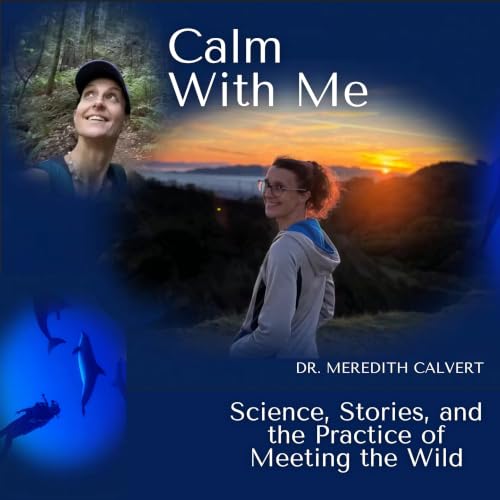
Cover of Calm With Me

Calm With Me

Calm With Me

By: Dr. Meredith Calvert
Listen for free

Season's Savings | 0.99 €/month for 3 months

5.99 €/month thereafter - terms apply. Cancel monthly.
Calm With Me blends neuroscience, yoga, adventure, and storytelling to explore how we build calm in real life, not in perfect conditions. Hosted by neuroscientist and yoga teacher Dr. Meredith Calvert, the podcast weaves together science-backed insight, nervous system tools, and stories from the trail, the ocean, and everyday life to help listeners navigate stress, uncertainty, burnout, and change with more steadiness and ease. Part science podcast, part reflective companion, Calm With Me is for anyone craving a slower nervous system, a fuller life, and a little more wonder along the way.Dr. Meredith Calvert Exercise & Fitness Fitness, Diet & Nutrition Hygiene & Healthy Living
Episodes
  • Take It Outside: The Neuroscience Behind Meditating in Nature
    26 Sep 2026
    Your meditation cushion works better on grass than carpet, and there's real science behind why.In this episode of Calm With Me, Dr. Meredith Calvert explores why taking mindfulness practice outside can transform it, drawing on her own journey from a stuffy MBSR classroom in graduate school to unexpected backyard encounters with a territorial squirrel, a curious hummingbird, and a remarkably calm coyote. She unpacks the neuroscience of attention restoration theory, explaining how nature's "soft fascination" lets our overworked directed attention finally rest, and shares research on Shinrin-yoku (forest bathing) showing that mindfulness paired with nature outperforms either alone, cutting cortisol, blood pressure, and rumination.A Swedish study gets special attention: outdoor and indoor mindfulness courses produced similar benefits, but outdoor participants had dramatically better follow-through, 90% completion versus 73%. Meredith argues this is really a story about adherence, not meditation.The episode closes with eight practical tips for starting an outdoor practice, no perfect conditions required. Plus: the 2027 WildCalm Retreats waitlist is now open!! Mentioned in this episode:The WildCalm retreats waitlist for 2027 is now open. All WildCalm retreats are small by design, and I expect them to fill quickly. If any of these is calling to you, joining now means you'll hear from me first.⁠[Join the private waitlist]⁠No commitment or payment yet, just your place in line. Immersive experiences designed to help you slow down, breathe more deeply, and reconnect with yourself, through movement, breath, and nature. Find out more: ⁠⁠⁠⁠⁠ ⁠⁠⁠⁠⁠⁠⁠WildCalm Retreats⁠⁠⁠⁠⁠⁠Follow me on Instagram: ⁠⁠⁠⁠⁠⁠⁠⁠⁠@meriyogasf ⁠⁠⁠⁠⁠⁠⁠⁠Time Stamps:0:15 – Intro: who Meredith is, Wild Calm Retreats 1:15 – Mindfulness-based Stress Reduction (by Jon Kabat-Zinn) in Grad school 2:15 – Meditation during pregnancy/early motherhood 3:00 – The dishwasher rage moment 3:25 – Re-enrolling in MBSR with Wendy Beckerman 4:20 – A Zen proverb (sit for 20 min, or an hour if too busy) 4:50 – Thanksgiving trip sets up the breakthrough 5:20 – Going outside in the cold morning air 6:40 – The backyard squirrel 7:15 – The calm coyote 7:45 – "Here's where the neuroscientist in me shows up" 9:00 – Soft fascination vs. directed attention (the "40 tabs" analogy) 9:30 – Shinrin-yoku (forest bathing) study 10:05 – Swedish REST study 11:15 – Reframing this as a story about adherence 11:50 – Kids meditating outside 12:30 – Pulling it together: attention + restoration 12:50 – The neuroplasticity bonus 13:10 – Clearing out common excuses 15:35 – 8 Tips for starting an outside meditation practice 19:15 – Weekly assignment 20:25 – 2027 WildCalm Retreats waitlist + sign-offReferences:Basu, A., Duvall, J., & Kaplan, R. (2019). Attention Restoration Theory. *Environment and Behavior, 51(8).Olson, E. R. T., Hansen, M. M., & Vermeesch, A. (2020). Mindfulness and Shinrin-Yoku: Potential for Physiological and Psychological Interventions During Uncertain Times. International Journal of Environmental Research and Public Health*, 17(24)* Lymeus, F., Ahrling, M., Apelman, et al., (2020). Mindfulness-Based Restoration Skills Training (ReST) in a Natural Setting Compared to Conventional Mindfulness Training: Psychological Functioning After a Five-Week Course. Frontiers in Psychology, 11, 1560. * Barrable, A., Booth, D., Adams, D., & Beauchamp, G. (2021). Enhancing Nature Connection and Positive Affect in Children through Mindful Engagement with Natural Environments. International Journal of Environmental Research and Public Health, 18(9)* Argyriadis, A., Kopanakis, E., et al. (2024). The Impact of Outdoor in Nature Mindfulness on the Mental Well-being of Children and Adolescents. A Mental Health and Cross-cultural Approach. Mater Sociomed, 36(1), 73-76.
    Show more Show less
    21 min
  • Why We Go Outside to Find Ourselves
    6 Aug 2026
    Adventure used to mean conquest. Not anymore.In this episode of Calm With Me, Dr. Meredith Calvert traces a shift happening across diving, surfing, and rock climbing: the fastest-growing group of participants isn't chasing adrenaline, but a quieter, deeper connection with themselves. Drawing on her forthcoming Scuba Diving Industry magazine article, Meredith explores the neuroscience behind why the wild calms us, including Blue Mind, soft fascination, and the default mode network, and how these effortless attention states let our overstimulated brains finally quiet down.Featuring insights from Bethany Hamilton, Kelly Slater, Lynn Hill, and dive shop owner Brent Webb, this episode asks what happens when fear becomes the doorway to growth rather than the obstacle to it. Meredith also unpacks a stubborn gap: participation among women is surging in these sports, yet leadership and instruction remain overwhelmingly male.Plus: the 2027 WildCalm Retreats waitlist is now open - sign up using the link below.Calm With Me is hosted by Dr. Meredith Calvert: neuroscientist, yogi, Master Scuba Diver, and devoted student of the wild mind.Mentioned in this episode:The WildCalm retreats waitlist for 2027 is now open. All WildCalm retreats are small by design, and I expect them to fill quickly. If any of these is calling to you, joining now means you'll hear from me first.[Join the private waitlist]No commitment or payment yet, just your place in line. Immersive experiences designed to help you slow down, breathe more deeply, and reconnect with yourself, through movement, breath, and nature. Find out more: ⁠⁠⁠⁠ ⁠⁠⁠⁠⁠WildCalm Retreats⁠⁠⁠⁠⁠Follow me on Instagram: ⁠⁠⁠⁠⁠⁠⁠⁠@meriyogasf ⁠⁠⁠⁠⁠⁠⁠Time Stamps:01:10 - How self-development and wellness travel is changing dive tourism 01:50 - Soccer moms on scuba02:50 - How adventure changes us03:35 - E.E. Cummings and finding ourselves in the sea03:50 - Blue Mind04:15 - Soft fascination04:50 - Evolution of sensory awareness05:35 - Why being outside helps stop overthinking 05:50 - Scuba diving for personal growth06:35 - Changes in the surfing industry07:10 - Bethany Hamilton and passion bigger than fear07:50 - Kelly Slater and surfing as religion08:25 - Lynn Hill and climbing as moving meditation08:50 - We don't come to conquer09:15 - Changes in the climbing gym09:30 - Yoga for rock climbing10:10 - Female participation in rock climbing10:30 - Women still missing in leadership roles - climbing11:05 - Women still missing in leadership roles - diving11:40 - What links climbing, surfing and diving?12:10 - Adventure sports are good for our brains13:05 - Philosophy of WildCalm retreats13:50 - WildCalm retreats 2027 waitlist now openReferences:The Rise of the Wellness Diver: A Changing Audience. Scuba Diving Industry Magazine, July 2026.Calvert, M. (2026). Why Yoga Makes You a Better Scuba Diver. DiveNewsWire, May 2026.Nichols, W. J. (2014). Blue Mind: The Surprising Science That Shows How Being Near, In, On, or Under Water Can Make You Happier, Healthier, More Connected, and Better at What You Do.Murrin, E., Taylor, N., et al., (2023). Does physical activity mediate the associations between blue space and mental health? A cross-sectional study in Australia. BMC Public Health, 23.Basu, A., Duvall, J., & Kaplan, R. (2019). Attention Restoration Theory: Exploring the role of soft fascination and Mental Bandwidth. Environment and Behavior, 51(8), 956-981.McDonnell, A.S., Strayer, D.L., (2024). Immersion in nature enhances neural indices of executive attention. Sci Rep 14, 1845. Shifting Tides: Dive Industry Assessment & Strategies to Serve Today’s Scuba Divers. Business of Diving Institute. https://www.businessofdiving.com/scuba-analysis-strategy-planninghttps://www.businessofdiving.com/scuba-diver-socio-demographic-profile
    Show more Show less
    15 min
  • Your Wild Mind: From Fear to Flow in the Great Outdoors
    27 Jun 2026

    You're mid-route. Your foot slips. Before your rational brain catches up, something ancient takes over and your heart is hammering, your breath has gone short and shallow and your hands are gripping harder than they should.

    Fear in the outdoors is fast, physical, and deeply intelligent. And if you know how to work with it, it's one of the most powerful entry points to presence you'll ever find.

    In this episode, neuroscientist, diver and yoga teacher Dr. Meredith Calvert breaks down the three F's of outdoor performance: fear, focus, and flow. She explains what's actually happening in your brain on a crux, why panicking makes you breathe in exactly the wrong way, and how natural environments both challenge us and restore the cognitive resources that modern life burns through.

    The science is real. The tools are portable.

    Calm With Me is hosted by Dr. Meredith Calvert — neuroscientist, yogi, Master Scuba Diver, and devoted student of the wild mind.

    Mentioned in this episode:

    • Come with me to find your own Wild Mind?

    I built my WildCalm retreats around exactly this. Immersive experiences designed to help you slow down, breathe more deeply, and reconnect with yourself, through movement, breath, and nature.

    Next adventure? SeaCalm Yoga & Scuba Diving in Roatán, Honduras, this Labor Day (2026). No yoga or scuba experience needed. Just curiosity, and a willingness to let the ocean do what it does best.

    Find out more: ⁠⁠⁠https://meriyoga.org/seacalm2026⁠⁠⁠

    • ⁠⁠⁠⁠WildCalm Retreats⁠⁠⁠⁠
    • Follow me on Instagram: ⁠⁠⁠⁠⁠⁠⁠@meriyogasf ⁠⁠⁠⁠⁠⁠

    Time Stamps:

    01:20 - Calm is a super power

    01:40 - Three brain structures involved with fear

    01:50 - The amygdala- your alarm center

    02:15 - The prefrontal cortex - your logic center

    02:50 - The hippocampus - your memory vault

    03:20 - Inhibitory learning

    03:40 - Introduction to box breathing

    04:00 - Practice: Box breathing

    04:30 - Panic and your breath

    04:55 - The Bohr effect

    05:20 - The CO2 spike or hypercapnia

    06:00 - Auto-occlusion

    07:15 - Introduction to reflexive breathing

    07:30 - Practice: Reflexive breathing

    08:00 - Focus and attention restoration theory

    08:30 - Directed attention

    08:55 - Involuntary attention

    09:30 - Soft fascination

    10:25 - Finding flow

    10:55 - Flow and the vagus nerve

    11:30 - Heart rate variability

    11:50 - Anchor practice for flow: 5, 4, 3, 2, 1

    13:00 - Fear is not a design flaw

    Scientific references:

    • Kaplan, S. The restorative benefits of nature: Toward an integrative framework, J. Env. Psych. 1995. 15(3):169-182

    • Pham TP & Sanocki T. Human Attention Restoration, Flow, and Creativity: A Conceptual Integration. J Imaging. 2024 Mar 29;10(4):83

    • McDonnell, A.S., Strayer, D.L. Immersion in nature enhances neural indices of executive attention. Sci Rep 14, 1845 (2024)

    • Williams, KJH, Lee, KE, Hartig, T., et al. Conceptualising creativity benefits of nature experience: Attention restoration and mind wandering as complementary processes, J. Exp. Psych. 2018 (59), 36-45,

    • Colzato, LS., Szapora A, Hommel, B. Meditate to Create: The Impact of Focused-Attention and Open-Monitoring Training on Convergent and Divergent Thinking. Front. Psych. 2012, 3.

    • Lippelt DP, Hommel B, Colzato LS. Focused attention, open monitoring a n d loving kindness meditation: effects on attention, conflict monitoring, and creativity - A review. Front Psychol. 2014 S e p 23;5:1083.


    Show more Show less
    14 min
adbl_web_anon_alc_button_suppression_t1
No reviews yet