

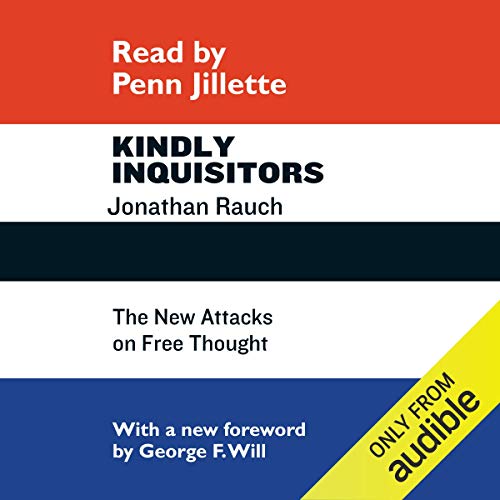
Kindly Inquisitors
The New Attacks on Free Thought, Expanded Edition
Impossible d'ajouter des articles
Échec de l’élimination de la liste d'envies.
Impossible de suivre le podcast
Impossible de ne plus suivre le podcast
Bénéficiez gratuitement de Standard pendant 30 jours

Kindly Inquisitors
Acheter pour 15,48 €
-
Lu par :
-
Penn Jillette
-
De :
-
Jonathan Rauch
"A liberal society stands on the proposition that we should all take seriously the idea that we might be wrong. This means we must place no one, including ourselves, beyond the reach of criticism; it means that we must allow people to err, even where the error offends and upsets, as it often will." So writes Jonathan Rauch in Kindly Inquisitors, which has challenged listeners for more than 20 years with its bracing and provocative exploration of the issues surrounding attempts to limit free speech. In it, Rauch makes a persuasive argument for the value of "liberal science" and the idea that conflicting views produce knowledge within society.
In this expanded edition of Kindly Inquisitors, a new foreword by George F. Will strikingly shows the book's continued relevance, while a substantial new afterword by Rauch elaborates upon his original argument and brings it fully up to date. Two decades after the book's initial publication, while some progress has been made, the regulation of hate speech has grown domestically - especially in American universities - and has spread even more internationally, where there is no First Amendment to serve as a meaningful check. But the answer to bias and prejudice, Rauch argues, is pluralism - not purism. Rather than attempting to legislate bias and prejudice out of existence or to drive them underground, we must pit them against one another to foster a more vigorous and fruitful discussion. It is this process that has been responsible for the growing acceptance of the moral acceptability of homosexuality over the last 20 years. And it is this process, Rauch argues, that will enable us as a society to replace hate with knowledge, both ethical and empirical.
©2013 Jonathan Rauch (P)2013 Cato Institute