

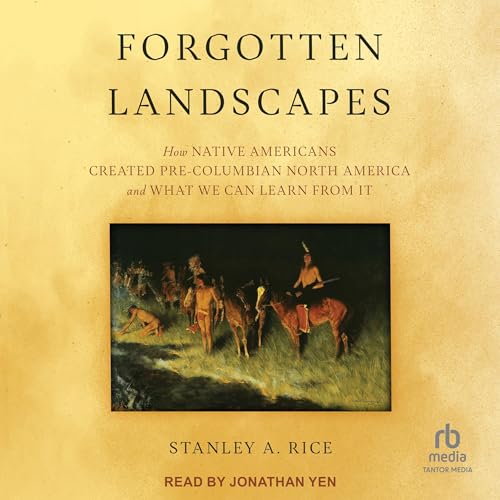
Forgotten Landscapes
How Native Americans Created Pre-Columbian North America and What We Can Learn from It
Impossible d'ajouter des articles
Échec de l’élimination de la liste d'envies.
Impossible de suivre le podcast
Impossible de ne plus suivre le podcast
Bénéficiez gratuitement de Standard pendant 30 jours

Forgotten Landscapes
Acheter pour 17,99 €
-
Lu par :
-
Jonathan Yen
-
De :
-
Stanley A. Rice
North America was not empty nor were its inhabitants savages when Europeans arrived in 1492. Quite the opposite, North America was thickly populated by indigenous people who lived in clean cities, had a thriving economy, and transformed the landscape into bountiful productivity. Forgotten Landscapes reveals the incredible extent to which Native Americans manipulated and shaped their surrounding environs through agricultural practices and urban engineering, resulting in one of the most prosperous civilizations of their time.
Well before European contact, North American cities and villages were bound together by an intricate trade network. Today, Spiro Mound in rural Oklahoma is a few piles of dirt, not on the road to anywhere. But at the time of the Mississippian civilization, about a thousand years ago, it was one of the largest cities in the world. With the controlled use of fire, Native Americans had transformed thick forests into open woodlands and expanded the ranges of prairies. Through organized hunting, Natives controlled the populations of prey animals such as passenger pigeons, and when Native populations grew large enough, they developed agriculture including irrigated crops, and even orchards.
In this fascinating and overdue book, author Stanley A. Rice shows his audience the Pre-Columbian landscape of America that has been largely forgotten.
©2025 Stanley A. Rice (P)2025 Tantor Media