

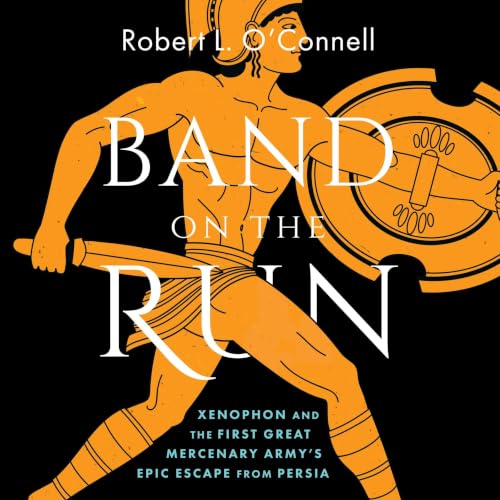
Band on the Run
A Greek Army's Epic Escape from Persia and the Makings of the Modern Mercenary
Unable to add items
Sorry, we're unable to add the item because your cart is already full.
Add to basket failed.
Please try again later
Add to wishlist failed.
Please try again later
Failed to remove from Wish List.
Please try again later
Adding to library failed
Please try again
Unable to follow podcast
Unable to unfollow podcast
0.99 €/mo for 3 months
Auto-renews at 5.99 €/month after 3 months. Cancel monthly.
Offer ends on 28 December, 2026.

Band on the Run
Narrated by:
Sean Patrick Hopkins
Buy Now for €17.99
-
Narrated by:
-
Sean Patrick Hopkins
Summary
400 BC. The Persian prince Cyrus the Younger hires an army of Greek soldiers to oust his brother from the Persian throne. But when Cyrus dies in battle during the army’s trek through the middle east, the army is stranded deep in enemy territory.
Led by Xenophon, a young Athenian philosopher turned solider, the Ten Thousand fought their way home through deserts and mountains, snowstorms, starvation, and relentless attacks, evolving into one of the most fearsome forces of the ancient world. Their journey, chronicled in Xenophon’s Anabasis, is one of history’s greatest military stories.
In Band on the Run, Robert O’Connell not only gives us an exciting and witty retelling of this story, but he has done so with a wise contemporary spin. For in his estimation, this was the battle that established the use of powerful mercenary forces. The attempted conquest of the Ten Thousand begins a historical line through Western history of the use of mercenary armies that has lasted up to our present day. And, as O’Connell shows, much misery and tragedy in human history has been due to this trajectory. This is a brilliant revisionist history with important lessons for our time.
adbl_web_anon_alc_button_suppression_t1
Reviews
"Mr. O’Connell relates this tale with verve, but also with impressive accuracy. His book is more than a gripping historical narrative. It gives unique insight into the meaning of history, the moral problem of military dominance by one culture over others and the corrosive effect—in the Hellenic world as elsewhere—of the allure of money."
—Wall Street Journal
—Wall Street Journal
No reviews yet